Selecting a reliable hepa filter paper factory is often the most critical decision for manufacturers of high-efficiency air filtration systems. The performance of the final filter depends not on the housing or the frame, but on the microscopic architecture of the filter media itself.
For industries requiring stringent air purity, such as pharmaceutical cleanrooms or semiconductor fabrication, the nuances of glass microfiber and synthetic composite materials determine whether a system meets ISO standards or fails under operational pressure.
This guide examines the technical capabilities and procurement benchmarks essential when evaluating a production facility, ensuring that the chosen media balances filtration efficiency with sustainable pressure drop.

Technical Foundations of HEPA Media Production

A sophisticated hepa filter paper factory does not simply "make paper"; it engineers a precise matrix of fibers. The process typically involves the deposition of glass microfibers or synthetic polymers onto a supporting substrate, creating a dense, random web capable of capturing particles as small as 0.3 microns.
The core challenge in production is maintaining uniformity across the entire roll. Any localized variation in fiber density can create "pinholes" or leakage paths, which compromise the integrity of the entire filtration unit. This is why advanced manufacturing focuses on controlled melt-blown processes and precision lamination.
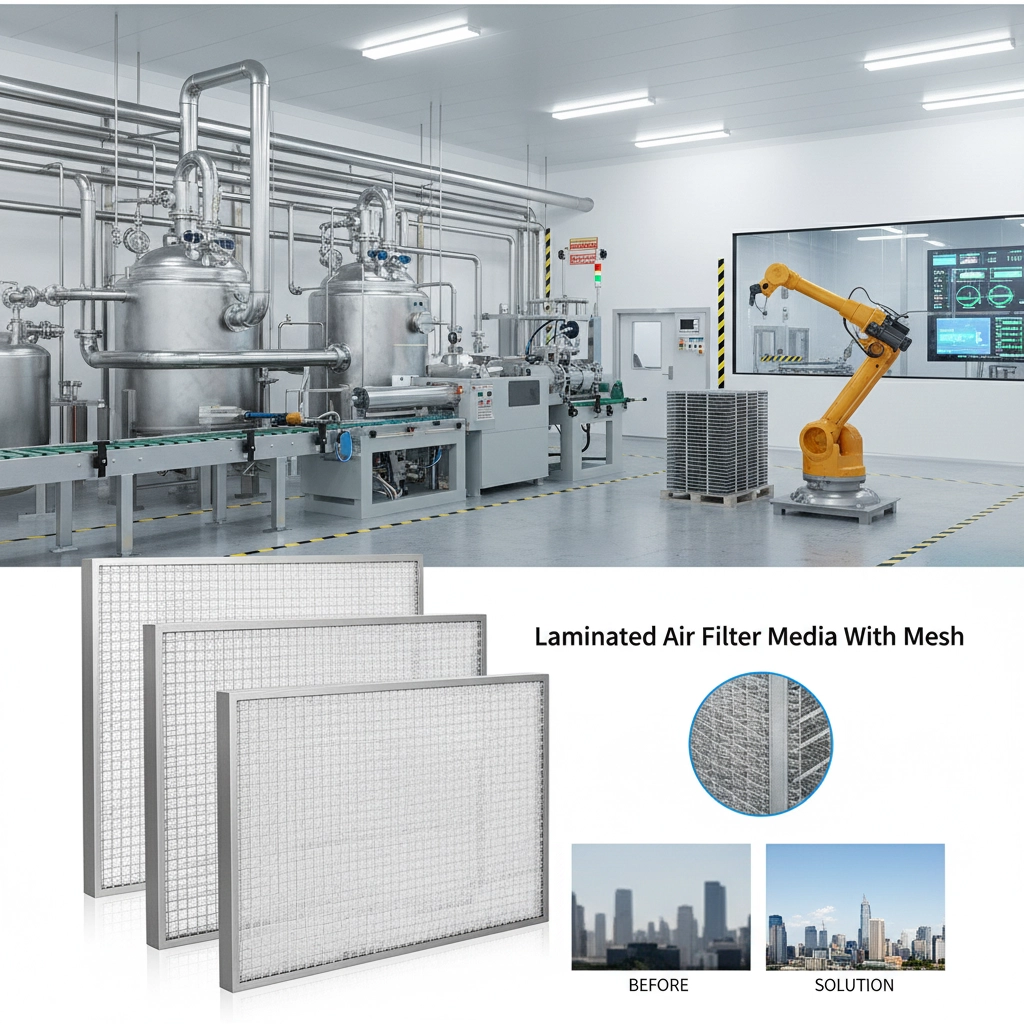
Furthermore, the integration of support materials, such as wire mesh or non-woven fabrics, ensures that the delicate HEPA media can withstand the mechanical stresses of air velocity without rupturing, a critical requirement for industrial-grade applications.
Key Performance Indicators for High-Efficiency Media
When evaluating media from a factory, two metrics dominate the conversation: the filtration efficiency (the percentage of particles captured) and the initial pressure drop (the resistance to airflow).
High efficiency is often achieved by increasing fiber density, but this inevitably leads to a higher pressure drop, increasing the load on fans and HVAC systems. A premium manufacturer utilizes optimized fiber diameters and pore distributions to break this linear trade-off.
Beyond these, structural stability—specifically the resistance to moisture and chemical degradation—is vital. For instance, Glass Microfiber Filter Media offers excellent heat resistance, whereas synthetic composites may be preferred in high-humidity environments to prevent fiber collapse.
Critical Application Scenarios for HEPA Filter Paper
The deployment of HEPA media varies significantly based on the contamination risk and the required air exchange rates. In pharmaceutical cleanrooms, the media must ensure absolute sterility, often requiring a combination of HEPA and ULPA grade materials.
In automotive and industrial settings, the focus shifts toward protecting sensitive machinery. For example, air intake systems for precision electronics manufacturing utilize HEPA materials to prevent microscopic dust from causing short circuits on silicon wafers.
Additionally, the use of Laminated Composite Filter Media allows for multi-stage filtration, where a pre-filter removes larger debris, extending the lifespan of the expensive HEPA layer and reducing the total cost of ownership for the facility operator.
Analyzing Filtration Efficiency vs Pressure Drop
The efficiency of a HEPA filter is measured by its ability to capture the Most Penetrating Particle Size (MPPS). While larger particles are caught by impaction and smaller ones by diffusion, the MPPS represents the hardest size to trap.
A high-performance factory optimizes the fiber diameter to ensure that the "dip" in efficiency at the MPPS is as shallow as possible, maintaining a consistent capture rate across a broad spectrum of particle sizes.
hepa filter paper factory Performance Metrics
As shown in the benchmark comparison, optimized media can maintain high efficiency while reducing the pressure drop by a significant margin compared to standard generic media, leading to lower operational energy costs.
Strategic Procurement and Factory Audit Benchmarks
When auditing a potential supplier, procurement officers must look beyond the catalog specifications. A true quality assessment involves reviewing the factory's quality control (QC) protocols for every roll produced.
It is essential to verify if the factory uses automated scanning technology to detect defects during the production phase. Manual sampling is often insufficient for the precision required in HEPA applications.
Moreover, the ability of the supplier to provide customized weights and thicknesses—adapting the media to the specific air velocity of the client's system—distinguishes a commodity vendor from a strategic technical partner.
Innovation Trends in Synthetic Composite Media
The industry is currently shifting toward Meltblown and Synthetic Composite Filter Media. These materials offer a compelling alternative to traditional glass microfiber by providing higher moisture resistance and reduced fragility during installation.
Electrostatic charging technology is another significant trend. By imparting a permanent electrostatic charge to the fibers, factories can increase particle capture efficiency without increasing the physical density of the media, effectively lowering the pressure drop.
Future developments are likely to focus on biodegradable synthetic polymers, reducing the environmental impact of filter disposal without compromising the stringent air quality standards required by global health and safety regulations.
Comparative Analysis of HEPA Material Technologies
Choosing the right material requires a deep understanding of the operational environment. Not all "HEPA" papers are created equal; the chemical composition dictates the lifespan and efficiency of the filter.
The following table compares the most common media types produced in a professional factory setting to help procurement teams align material selection with application needs.
| Media Type | Primary Advantage | Operating Limit | Typical Use Case |
|---|---|---|---|
| Glass Microfiber | Extreme Efficiency | Fragile to Vibration | Hospital Cleanrooms |
| Synthetic Composite | Moisture Resistant | Lower Heat Limit | HVAC Industrial Units |
| Meltblown Polypro | Cost Effective | Lower Capture Rate | General Air Prefilters |
| Laminated Mesh | Mechanical Strength | Higher Pressure Drop | High-Velocity Airflow |
| Electrostatic Media | Low Energy Loss | Charge Decay Over Time | Consumer Air Purifiers |
| Composite Fiberglass | Balanced Stability | Moderate Cost | Chemical Processing Plants |
Ultimately, the decision should be based on the balance of initial cost, energy expenditure over the filter's life, and the absolute minimum efficiency required by the regulatory body governing the specific industry.
Frequently Asked Questions
Conclusion
The selection of a hepa filter paper factory is a technical partnership that directly impacts the operational efficiency and safety of air filtration systems. By prioritizing a balance between capture efficiency and pressure drop, and auditing the factory's commitment to uniformity and material science, companies can avoid the costly risks of system leakage and premature filter failure.
For organizations seeking high-performance media, including Glass Microfiber or Synthetic Composites, detailed technical specifications and company capabilities can be reviewed through www.filtersmaterials.com.