This FAQ answers practical questions about composite fiberglass filter paper, including its glass fiber and nonwoven construction, available grades, technical values, one-side and both-side options, applications and the information to include in a specification request.
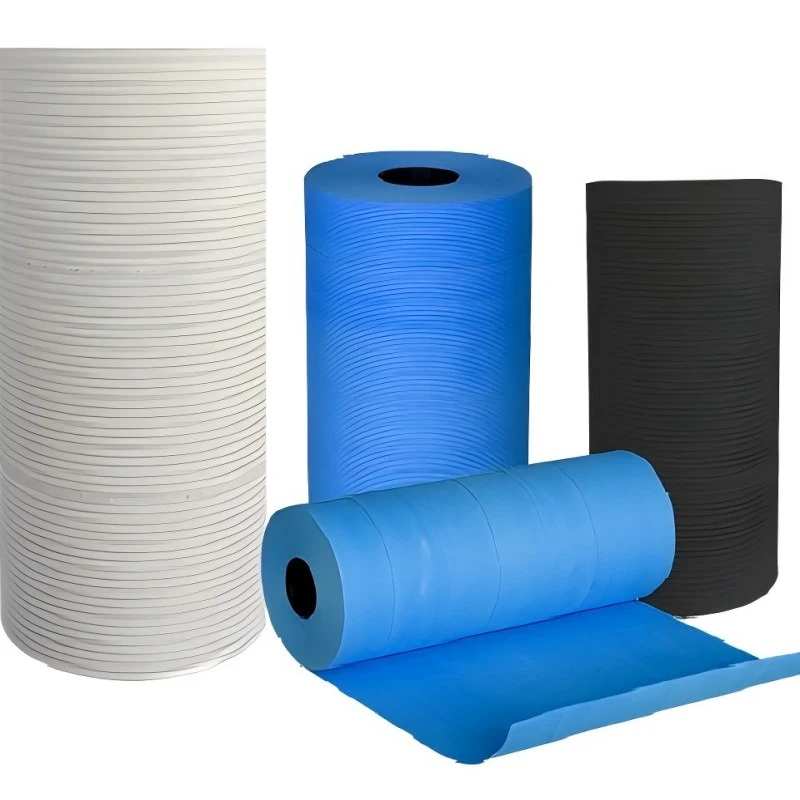
Composite fiberglass filter paper combines ultra-fine glass fiber paper with nonwoven fabric. The nonwoven layer can be applied to one side or both sides, giving buyers clear construction choices when matching filtration media to a filter element and its operating requirements.
The material uses ultra-fine glass fibers formed into glass fiber paper by a wet process. Nonwoven fabric is combined with the glass fiber paper on one or both sides to protect the core material. The product is characterized by high dirt-holding capacity, low resistance, high strength and stable performance.
The listed grades are ZSU1, ZSH3, ZSH5, ZS10, ZS15, ZS20, ZS25 and ZS30. Their corresponding particle ranges are 1, 2 to 3, 4 to 6, 8 to 12, 13 to 17, 18 to 22, 23 to 27, and 28 to 32 micrometers. Select the grade by matching the required particle range with the filter design and flow conditions.
Compare basis weight, air permeability, resistance, mean pore size, efficiency, tensile strength and thickness. Across the listed grades, air permeability is 20 to 420 L/m²·s, resistance is 1 to 41 mm H₂O, mean pore size is 20 to 150 μm, and efficiency at 0.3 μm and 5.3 cm/s is 15% to 99.99%.
The table gives a tensile strength of 2 kN/m for the listed grades. Basis weight is 130 g/m² for both-side composite material. One-side composite material has basis weight values of 90 or 100 g/m² across the listed grades. Thickness is 0.5 ± 0.1 mm for both-side composite material and 0.4 ± 0.1 mm for one-side composite material.
Nonwoven fabric can cover one side or both sides of the glass fiber paper. Both-side composite material has a listed basis weight of 130 g/m² and thickness of 0.5 ± 0.1 mm. One-side composite material has listed basis weight values of 90 or 100 g/m² and thickness of 0.4 ± 0.1 mm.
For a filter element with limited space, compare the construction thickness with the available installation space. Also check how the media will be supported and which side needs protection before requesting the material.
Listed uses include air compressors, automotive engines, fuel turbines, nuclear filtration and natural gas engineering. Application areas include automotive, heavy industry, petroleum, chemical, aviation, metallurgy and the nuclear industry. The grade, construction and technical values should match the filtration duty and equipment design.
Provide the required grade or particle range, one-side or both-side construction, target air permeability or resistance, required efficiency, thickness, intended application, dimensions and quantity. If the material will be installed in a filter element, include the available installation space and relevant design constraints.
For a quotation request, send the filtration medium, target grade, composite side, required dimensions and quantity together with the application details. These points give the supplier the information needed to review the material configuration.
The people

About the author
The company
Hebei Fangyu Filter Material Technology Co.,Ltd is the leading innovative developer and manufacturer all kinds of filter materials in China. Located in the economically developed Handan Hebei specialized in various kinds of filter materials from Synthetic Media, Pre- filter Non Woven Fabric ,Wire Mesh Backed Laminated Filter Media, Auto Cabin Filter Media, polypropylene filter media, Glass Microfiber Filter Media ,Pre- filter non woven fabric, activated carbon filter materials, EN779 bag filter materials, HEPA…
About Us ↗Visit company website ↗Your next step
Use case, specification, quantity and delivery window: make the next conversation specific.