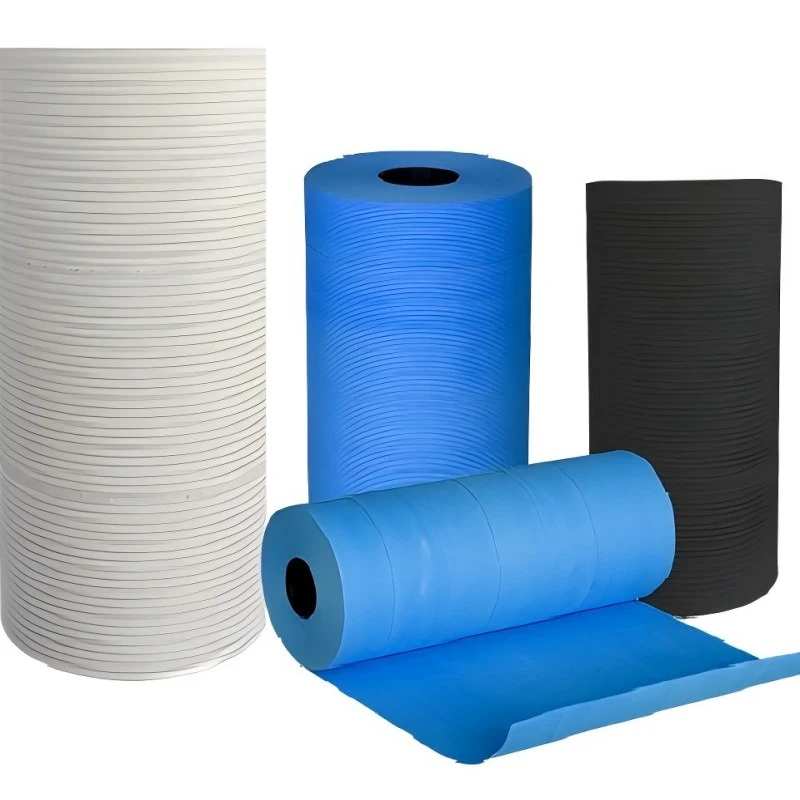
Air filter paper price should be reviewed with grade, thickness, airflow, pore size, strength, and application together. Nanofiber Air Filter Paper covers commercial vehicle intake systems, gas turbines, air compressors, industrial dust removal, and heavy-duty truck filters, with F7, F8, F9, E11, and antistatic F9 options. This guide shows which specification points to send when requesting a useful quotation.
Application and filter duty: match the paper to commercial vehicle intake, gas turbine, air compressor, industrial dust removal, or heavy-duty truck use.
Grade and performance values: compare filtration efficiency, resistance, air permeability, gram weight, thickness, corrugation depth, maximum hole diameter, and bursting strength.
Element fit: confirm width, pleat design, element dimensions, and any antistatic requirement before requesting a quotation.
Air filter paper price is meaningful only after the filter requirement is fixed. A roll selected for a commercial vehicle intake system may need a different grade, airflow, or pore size from media intended for industrial dust removal. We supply Nanofiber Air Filter Paper in several grades, so the first purchasing decision is the performance range your filter element must meet.
Nanofiber Air Filter Paper is suited to commercial vehicle intake systems, gas turbines, air compressors, industrial dust removal, and heavy-duty truck filters. The application affects the balance between filtration efficiency, resistance, dust capacity, and mechanical strength.
For a commercial vehicle or heavy-duty truck intake filter, the F7, F8, or F9 grades provide a practical starting point. Their listed filtration efficiencies are at least 35%, 55%, and 70%, with resistance values of no more than 80, 50, and 90 respectively. The grade choice should follow the air-cleaning requirement and the filter element design, not the product name alone.
Gas turbine and air compressor systems require attention to airflow and resistance because the media sits in a moving air path. F7 has an air permeability of 200 ± 50, F8 has 350 ± 50, and F9 has 180 ± 50. These values help you compare the airflow behavior of the grades when you prepare a quotation request.
The available grades use gram weights from 120 ± 5 to 140 ± 5, thicknesses from 0.30 to 0.68, and corrugation depths from 0.25 to 0.38. These values affect how the paper fits the pleating and element construction. Send the required basis weight, thickness, and corrugation depth with your drawing or current filter sample.
Maximum hole diameter is also grade-dependent. F7, F8, and F9 are listed at no more than 55, 90, and 65, while E11 is listed at no more than 65. Bursting strength is listed at 240 ± 70 for F7, F8, F9, and E11. Antistatic F9 uses a separate specification with a gram weight of 140 ± 5, thickness of 0.30, corrugation depth of 0.25, air permeability of 178, maximum hole diameter of 63, and bursting strength of 250.
These details matter when you are matching replacement media to a pleated element. Picture a truck intake filter being assembled with fixed pleat spacing: a change in thickness or corrugation depth can affect the fit of the finished pack. Include the element dimensions and pleat design in your inquiry so we can match the paper to the construction.
F7, F8, and F9 are the main choices when the filter is intended for vehicle intake, gas turbine, compressor, or industrial dust-removal use and the required filtration level falls within their listed ranges. F7 combines 120 ± 5 gram weight, 0.65 ± 0.10 thickness, and 200 ± 50 air permeability. F8 uses 125 ± 5 gram weight, 0.68 ± 0.10 thickness, and 350 ± 50 air permeability. F9 uses 133 ± 5 gram weight, 0.65 ± 0.10 thickness, and 180 ± 50 air permeability.
E11 is the appropriate option in this product range when the filter design calls for at least 95% filtration efficiency. It has a gram weight of 133 ± 5, thickness of 0.65 ± 0.10, corrugation depth of 0.30 ± 0.10, air permeability of 120 ± 50, maximum hole diameter of no more than 65, bursting strength of 240 ± 70, and resistance of no more than 110.
Antistatic F9 suits a design that specifically calls for antistatic media. Its listed properties differ from the standard F9 values, so treat it as its own selection when preparing the filter specification. Do not replace one with the other on grade name alone.
A useful request should identify the application, target grade, required width, and roll or sheet format. Add the current paper specification, including gram weight, thickness, corrugation depth, air permeability, maximum hole diameter, bursting strength, filtration efficiency, and resistance where applicable.
For example, a buyer replacing media in a heavy-duty truck filter can send the vehicle or filter application, the existing paper grade, element dimensions, pleat spacing, and required filtration efficiency. A buyer working on a gas turbine or compressor filter should also send the airflow requirement and the acceptable resistance range. These details let us assess whether F7, F8, F9, E11, or antistatic F9 is the right starting point before discussing air filter paper price.
F9 is listed with filtration efficiency of at least 70%. It has a gram weight of 133 ± 5, thickness of 0.65 ± 0.10, corrugation depth of 0.30 ± 0.10, air permeability of 180 ± 50, maximum hole diameter of no more than 65, bursting strength of 240 ± 70, and resistance of no more than 90. Use these values when matching F9 to an existing element design.
E11 has the highest listed filtration efficiency in this product range, at least 95%. Its air permeability is 120 ± 50 and its resistance is no more than 110. That combination gives you a clear specification point for a higher-efficiency filter design. Send the element dimensions and airflow requirement with the inquiry so the grade can be checked against the finished filter.
No. Antistatic F9 has its own listed values: 140 ± 5 gram weight, 0.30 thickness, 0.25 corrugation depth, air permeability of 178, maximum hole diameter of 63, bursting strength of 250, and F9/EN7 79 filtration classification. Choose it when the filter construction requires antistatic media, and include that requirement in the quotation request.
Nanofiber Air Filter Paper fits buyers who need media for vehicle intake, gas turbine, air compressor, industrial dust removal, or heavy-duty truck filtration and can define the required grade and element construction. Send the application, target grade, width, element dimensions, pleat details, airflow, resistance limit, and required quantity when asking us for a quotation.

About the author
The company
Hebei Fangyu Filter Material Technology Co.,Ltd is the leading innovative developer and manufacturer all kinds of filter materials in China. Located in the economically developed Handan Hebei specialized in various kinds of filter materials from Synthetic Media, Pre- filter Non Woven Fabric ,Wire Mesh Backed Laminated Filter Media, Auto Cabin Filter Media, polypropylene filter media, Glass Microfiber Filter Media ,Pre- filter non woven fabric, activated carbon filter materials, EN779 bag filter materials, HEPA…
About Us ↗Visit company website ↗